The best books I read in 2025
Why had I not heard of the School of Chartres?

This year I quit my academic career in theoretical physics, moved to San Francisco to join a startup, wrote a gargantuan essay on the incompleteness of physics, and ramped up my dabbling in visual arts. Reading books was on the back-burner. Nevertheless, what little I read was stellar. Below are my three favorite reads from 2025:
1. Universe of Stone by Philip Ball
Ball tells the story of the Gothic cathedrals through the prism Chartres—one of the most important and best preserved examples of classic gothic style. It was built between 1193-1250 and was associated with the School of Chartres—the precursor to the medieval universities and possibly the most important European place of learning at the time. I rarely read books twice, but this will be an exception.
I was especially surprised to have never heard about the School of Chartres—a place of seeming great significance to the development of Western civilization:
It is no exaggeration to say that the impulse to understand the world, which found a voice in thirteenth-century Oxford and flourished in the great universities of Renaissance Italy, found its first medieval expression in the chilly chambers that clustered around the imposing Romanesque church of Chartres. […]
The eminence of the Chartres school was kindled by the man whose effigy now stands in front of the cathedral’s twin spires. The Italian Fulbert of Chartres (born c.960-70) was a pupil of the great tenth-century scholar Gerbert of Aurillac, a man so learned in mathematics and the sciences that, despite becoming the first French pope (Sylvester Il) in 999, he was rumoured to be a magician in league with the devil. […]
Thanks to Fulbert, Chartres became for at least a hundred years one of the principal conduits of Arabic science and mathematics, and it was here that these discoveries became integrated into Christian thought. […]
In one sense the spirit of rationalistic, proto-scientific inquiry that was developed at Chartres by Thierry and pursued by his successors can be seen as a natural outcome of the emerging humanism of the times, a consequence of the fresh influx of classical texts in Latin translation. But this was more than a question of the western assimilation of ‘new’ knowledge. The whole idea of studying nature for its own sake, and of looking for rational causes for natural phenomena, was new to medieval Europe, and signaled a profound shift in thinking.
Previously, the only reason to study the mundane world was to uncover symbols for moral instruction. Things were the way they were because God willed it so, and if there was logic or reason to be found, that was simply an illustration of the wisdom and foresight of the Creator.
The Platonism of Chartres was not the same as the Neo-Platonism of Renaissance philosophers such as Marsilio Ficino and Pico della Mirandola, which emphasized the Gnostic mysticism of Plato’s interpreter Plotinus rather than the rationalism of his elemental physics.
For the Chartrains, nature was a network of laws that reason could penetrate, and they believed in what we might now call the Baconian accumulation of knowledge through experience, rather than the Neo-Platonic Light of Nature’ as a source of revelation.
On medieval churches and cathedrals
Thus, while later artists presented real events as allegories, medieval art does not generally concern itself with 'real events' at all, because what is truly real is not the particular event but the concept it embodies.
It would not be stretching the point too far to say that this art was performing a function that science aims to fulfill today: to simplify the world, to strip away what is contingent from what is essential, to reveal the framework. Art existed to reveal the deep design of God's creation. […]This is why it can be misleading to call medieval churches works of art at all. That is supposed to be a way of venerating them - a way that even the secular observer can appreciate—but in fact it merely encourages us to think about a church in the same way that we think about an Epstein sculpture or a Matisse canvas. While we might rightly praise the expressiveness of the statuary at Chartres or the elegant, soaring lines of the columns and arches, we should not imagine that the medieval worshippers did the same, or that they possessed anything comparable to our aesthetic sense of what to look for in art.
‘Contemporary man’, says the German archaeologist and historian Ernst Curtis, ‘places an exaggerated value on art because he has lost the feeling for intelligible beauty which the neo-Platonists and the Medievals possessed. This intelligible beauty that the builders of the cathedrals sought to convey was not an aesthetic but a moral reality.
For the record I doubt Ball’s claimed incomparability of our and their aesthetic appreciation for these buildings—I think spiritual and aesthetic feelings fundamentally similar. Of course, it would have resonated even more for people at that time.
Anyway, in our fascination for the scholars and clergy at Chartres, let us not forget the master builders:
The astonishing thing is that the master builders in fact had so little tradition on which to draw in the twelfth century. The methods and principles of the ancient architects were barely known, available only as sparse hints in encyclopedic works by Vitruvius and Pliny. Unlike the intellectuals in the cathedral schools, they had no giants' shoulders on which to stand. Yet they raised giants themselves. [..]
It ought to be obvious to art historians, if to no one else, that patrons, even the most enlightened and exigent of them, do not normally invent styles. So while it may be granted that any symbolism present in Gothic architecture was the contribution of the clergy rather than the craftsmen, at best it can have been no more than a partial and superficial factor in the design procedure... By its very nature medieval architecture involved mysterious operations that were excluded from the conspectus of the liberal arts and therefore beyond the understanding of even the most educated ecclesiastical patrons. […]
One of the main reasons why it is hard to know how design decisions were taken—and whether those decisions were modified by the builders during implementation—is that the drawings and plans for High Gothic churches such as Chartres, Amiens, Reims and Lyon are non-existent. It is not necessarily that they are lost; they may never have been made at all. According to the historian Robert Branner, until the thirteenth century a master builder formulated the plan of a building ‘in his head’, and then laid out the design directly on the ground without the intermediation of a drawing.
This book gave me inspiration to read Plato, so picked up I several of the dialogues afterwards: The Symposium, Euthyphro, Apology, Crito, Meno, and Phaedo. Universe of Stone plus these inspired me to produce this piece of music:
2. Pragmatism by William James
This booklet is a collection of lectures on the philosophical tradition of pragmatism. It hit me hard, and at the exact right moment in life. I absorbed a lot of momentum from it. In fact, I went so far as to call it
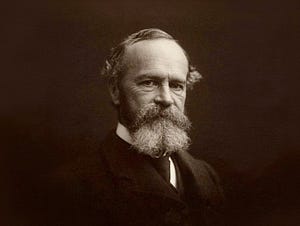
With James I feel I’m reading an intellectual kindred spirit to a degree I rarely experience. James takes the flux of our senses as the primary data stream, and he does not disregard its validity in shaping our beliefs just because we cannot quantify it in a fine grained way. As long as we operate with beliefs and truths that work for our goals, then that’s as real as real gets.
It is astonishing to see how many philosophical disputes collapse into insignificance the moment you subject them to this simple test of tracing a concrete consequence. There can BE no difference any-where that doesn't MAKE a difference elsewhere—no difference in abstract truth that doesn't express itself in a difference in concrete fact and in conduct consequent upon that fact, imposed on somebody, somehow, somewhere and somewhen. The whole function of philosophy ought to be to find out what definite difference it will make to you and me, at definite instants of our life, if this world-formula or that world-formula be the true one.
The cash value of your ideas and beliefs are the the only meaningful way to evaluate their reality and truthfulness. For example, if religion enables healthy-mindedness, then that obliges us to take it seriously:
You see by this what I meant when I called pragmatism a mediator and reconciler and said (…) that she unstiffens our theories. She has in fact no prejudices whatever, no obstructive dogmas, no rigid canons of what shall count as proof. She is completely genial. She will entertain any hypothesis, she will consider any evidence. It follows that in the religious field she is at a great advantage both over positivistic empiricism, with its anti-theological bias, and over religious rationalism, with its exclusive interest in the remote, the noble, the simple, and the abstract in the way of conception.
In short, she widens the field of search for God. Rationalism sticks to logic and the empyrean. Empiricism sticks to the external senses. Pragmatism is willing to take anything, to follow either logic or the senses, and to count the humblest and most personal experiences. She will count mystical experiences if they have practical consequences. She will take a God who lives in the very dirt of private fact-if that should seem a likely place to find him.
Her only test of probable truth is what works best in the way of leading us, what fits every part of life best and combines with the collectivity of experience's demands, nothing being omitted. If theological ideas should do this, if the notion of God, in particular, should prove to do it, how could pragmatism possibly deny God's existence? She could see no meaning in treating as 'not true' a notion that was pragmatically so successful. What other kind of truth could there be, for her, than all this agreement with concrete reality?
I’m currently reading The Varieties of Religious Experience, which is turning out to be fantastic.
3. On Justice, Power and Human Nature, excerpts from Thucydides with comments by Paul Woodruff
I keep hearing that modern society is one of the most historically illiterate that ever lived. I’ve never tried to check the claim, but it feels legit. I’m annoyed at myself for being so historically ignorant.
I’ve always wanted to read Thucydides’ history of the Peloponnesian War and the resulting fall of the Athenian democracy, but 8 volumes is quite the commitment. Thucydides was a general on the Athenian side of the war, and he is often referred to as the first historian who followed strict practices of evidence gathering and which attempted impartial analysis rather than emphasizing the role of the Gods.
Like the lightweight that I am, I chose a 100-pager of excerpts with remarks and interpretation by philosopher Paul Woodruff. This let me dip my toe, and it was a great little read. I’ll be reading Thucydides in my retirement.
What I did when I didn’t read