Ornaments from first principles
Grand unified theories and their pleasures
Humans love ornamentation. They also hate it. In general, it appears that people with a strong aesthetic compass have intense opinions about it, one way or another.
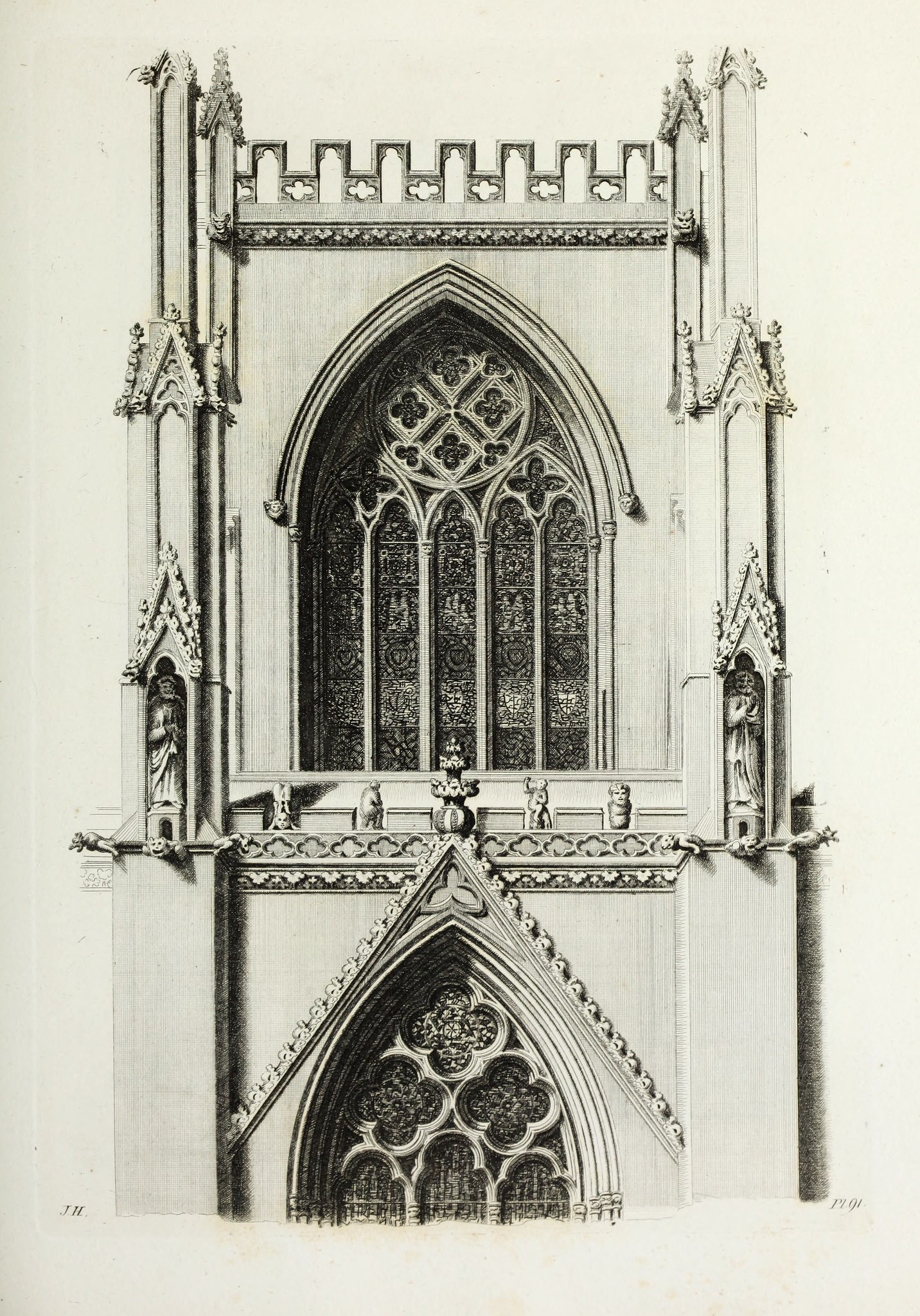
For me, ornaments can give a feeling of the sacred
or they can induce plain disgust

Most of the time, however, I feel neither. As many lament, there is little ornamentation on the buildings we construct these days. This is a lost opportunity for refining our spaces and by implication our mental states. Nevertheless, if I had to pick between Rococo and nothing, I’d choose the latter every time. But I’m glad I don’t have to pick. Across the street from me is a neoclassical building from the 1910s with a lovely white ornamented facade. I always rest my eyes there as I brew morning coffee. But the delight across the street has been making me think. How do ornaments work, at a fundamental level? Clearly there is something worth understanding here.
What is beauty?
To get to the heart of the matter, I must introduce a theory of aesthetic satisfaction that I am a strong subscriber to—namely, the proposal that aesthetic pleasure is the reward signal for success in predictive processing.
Predictive processing is the idea that the brain is constantly trying to predict its incoming sensory signals. This makes perfect sense. Accurately predicting your environment is obviously evolutionarily useful. Furthermore, success at prediction, even when you don’t care about the particular prediction itself, is indicative of something fundamental: you have learned a model of a small part of the world. Successful prediction is the robust way to check this.
Prediction is intimately tied to pattern recognition, since you should grade yourself on pattern recognition by completing the pattern having only seen parts of it. With that in mind, let me now draw the proposed connection to beauty and hammer home the evolutionary rationale. Quoting my piece Beauty as entropic fine-tuning:
The ability to recognize patterns is clearly useful for survival. Registering a subtle sound cloaked by the hiss of the wind can save you from a predator. Noticing a disturbance in the soil from animal tracks can lead you to your next meal. Intuiting weather patterns can ensure that you seek shelter in time for a storm. Discriminating subtle differences in the color of berries might prevent you from getting poisoned. Detecting the ire in the voice of a fellow caveman might defuse a situation that might otherwise have turned violent.
Not only is pattern recognition useful for survival, it is also something you can get better at with practice. If this is not immediately clear to you, play a random chord on a piano, and ask a beginner musician what notes were played; they will have no idea. Ask an expert musician, and they can likely tell you easily. To get to this level of pattern recognition in audio, however, the expert put in a lot of effort and practice. For humans to bother spending time on getting better at pattern recognition, at the expense of eating, mating, and chasing social status, evolution has ensured that there is a reward. That reward, I claim, is the sensation of beauty.
Beauty is inseparable from our senses, because our senses constitute the input data stream where patterns are to be found. Some patterns are so simple, or we have seen them so many times, that our brains have to do very little work to detect and decode them. There is nothing more to be learned from engaging with the sensory input signal. Thus, it is a waste of time paying attention to these patterns; we are not rewarded with a sense of beauty. The individuals who felt an overwhelming and never-fading sense of beauty from the wind were quickly rooted out of the gene pool.
On the other hand, there are some patterns so complex that a human can never decode them. For a computationally limited brain, these patterns are indistinguishable from a completely random signal. We do not find these beautiful, because again, those who did were wasting resources and thus were at a disadvantage in propagating their genes.
[…]
Objects of beauty are those which have patterns that are rich, novel, and decodable. It is crucial that a decoding task not be too easy - a criterion that is intimately tied to novelty. When we get sick of a song we've heard too many times, decoding the patterns in the audio has become too easy. In fact, we have effectively memorized the signal, so we can predict the sound that is about to enter our ear with extremely high fidelity. As a consequence, our sensation of beauty is degraded. An experience of beauty requires a level of surprise when encountering the signal, because a lack of surprise (i.e. too low entropy) means that there is nothing new to be learned. The signal was already completely predictable, so there is no reason for our brains to reward our engagement. Thus, I believe beauty emerges when our brains receive sensory input that lies in a finely tuned band of novelty and predictability.
We experience beauty when we subconsciously construct a world model capable of explaining intricate sensory data. And so, when we behold a great piece of art, our brain builds a little theory of science internal to the microcosm of the artwork. Or rather, it expands a grand unified theory we already possess, constructed across all our encounters with art, culture, and natural scenes of beauty. It can draw upon all the little lessons it has learned in previous encounters. However, when there is beauty, the theory we had before was not quite enough: there is precisely the right amount of novelty so that the task is difficult yet achievable.
Given how devoted humanity is to both beauty and understanding the world is, it is satisfying to find these concepts hand it hand.
I must make a brief side note here. While I stumbled across this idea in my own artistic pursuits, I was very late to the party. Neuroscientists had the same idea fifteen years ago, and one of the pioneers, Sander Van de Cruys, is even on Substack, so check out his writings. Now, back to ornaments.

Ornaments
Ornaments typically feature a highly detailed microstructure with strong elements of repetition. A small unit of pattern repeats or mutates, over and over.
The large number of repetitions is what makes ornaments a double-edge sword. As you behold a small portion of the pattern, your subconscious brain tries to crack the pattern. Then, as you move your gaze across the object in question taking in unit after unit, your brain gets to test its theory over and over. Then, it seems to me, one of the following things must happen.
First, the pattern might be too trivial. Too regular. No challenge for your brain. 100% hit rate. Boredom. Why not spend effort impressing a potential mate?
Alternatively, the pattern is too complex. Your brain finds no organizing principle. Chaos—then more chaos. And then some more. Dissatisfaction, in every repeating unit. The world cannot be fathomed, and this message is getting hammered home over and over.
But, if neither 1 nor 2 occurs, then you hit that magical fine-tuned zone, where the patterns lie just beyond what your brain’s grand unified theory of sensory input can comfortably predict. As you move your gaze across the visual field, your brain discovers new regularities. It gets to check that it has understood the underlying abstraction generating those regularities, multiple times over. Atoms of aesthetic satisfaction are dispensed, again and again and again and again and again.