Sacrality in leather boots (short story)
Durability and the weaving of meaning
Caught in a sticky web of sadness, Gregory M. almost walks past the warmly lit store. In a prayer for escape, however, he decides at the last moment to push through the heavy but shockingly-smoothly-opening door. As the interior of Golia reveals itself, carefully aimed spotlights shepherd his eye to a shrine. On top of it, a pair of leather boots glimmer in saddle tan. Above the boots hovers an embellished plaque. $129, it proclaims. As Mr M. parses the scene, a lady in angular dress launches a straight trajectory in his direction, wearing a smile that is indistinguishable from genuine. When Gregory M. leaves the store five minutes later, the formerly smiling lady pulls out a second identical pair of boots and carefully places them atop the altar.
The boots serve Gregory well. Or, at least they do at first. As he crosses the sixth month off his calendar, they unravel. A toe has dug through the leather that he now knows to be cheap, and the stitches have admitted they were just pretending to connect the soles to the uppers—something they must own up to now that the glue has given up on life. As the boots join the banana peels and empty milk cartons, Gregory thinks to himself that at least those hundred or so bucks bought him solid looks for a season.
Three years run past Gregory. Memories haven’t faded as he had hoped. And then to top it off, on the way to a particular appointment, one of Gregory’s heels falls off. More depressed glue. The hivemind residing at his thigh can however inform him that a cobbler is located just two minutes further down the street. The door to David’s boot lets out a screech of pain as Gregory interrupts the silent locale. A bearded little man in a stained leather apron lifts his gaze and nods, all in one combined movement. The man attempts something resembling a smile—he’s grumpy, but trying to hide it. As Gregory decides to move his gaze across the space, he sees a herd of leather boots grazing on all free surface area. None of them stands out, but as Gregory M. picks up a pair, their proportions give him an undefinable sense of satisfaction. Prices range from four hundred to multiples of that. But Gregory needs shoes right now, and the little man can assure him that the soles truly are stitched to the uppers. Given the pinch he’s in, he shells out what seems to be an outrageous amount of money. As he jogs towards his appointment, Gregory tries to memorize David’s instructions for how to care for the boots.
More years pass. Quite a few of them, in fact. Initially feeling bad having spent so much money on shoes, Mr. M. follows up with maintenance. Every third week he cleans them thoroughly, followed by conditioning. It takes 20 minutes or so. As he carries out his little ritual one Sunday, an imaginary conversation plays in his head. In it, the voice of his cousin with half an economics degree mocks him: in addition to spending a fortune on the boots, he has to spend all this time maintaining them. If Gregory were to count hourly wage for all that time, the real price of these shoes would be unjustifiable.
As Gregory M.’s worldline takes twist and turn, this little Sunday ritual stays constant. The shoes themselves don’t stay static, though; they develop a flamed, almost fractal patina on the caps due to contact with rainwater containing various chemicals. Inevitable scratches come to decorate the leather. Creases form and stabilize. And the stitches, they are loyal in their service. They even allow David to replace the soles for Gregory every couple of years.
Then one Saturday, on his morning walk, Gregory M. stumbles into a van Gogh exhibition that is visiting his city. Halfway through the exhibition, a painting enters his presence. It commands his freezing. He swallows and looks down.
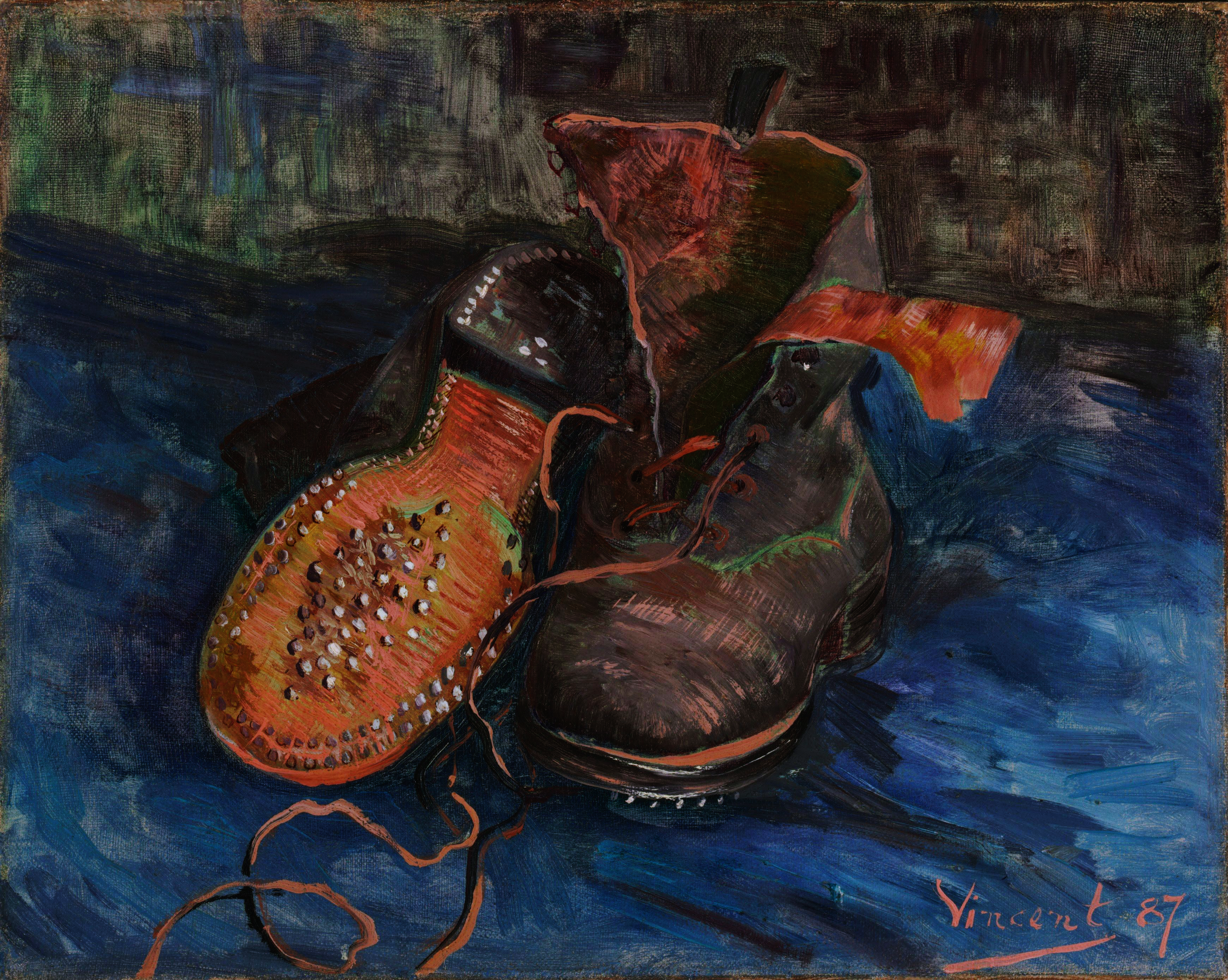
That night, Gregory M. eats a snip of herb and lies down on his couch. As the first hour passes, he feels his thoughts start to dance that strange dance. Concept gains color, color takes shape, shape weds emotion. Then, Gregory feels his mind grasping at the outlines of a mountainous structure. But just as he is about to hold it, it slips. And so his thoughts jump to a conversation he heard on the tram home. An unusual character in the seat behind Gregory was lecturing their friend on fugues—a type of musical composition that, if the stranger is to be trusted, is better described by analogy to weaving than any other form of music. A short melody, known as the subject, is introduced by a lone musical voice. Then as the piece evolves, new voices appear which repeat the subject across varying pitches and with slight and not-so-slight mutations. At the same time, other voices play new melodies that smoothly overlay the subject, using the technique of counterpoint. Gregory is not familiar with the term, but his curiosity is itching at this point. Quick research leads him to a fugue by Bach that appears to be beloved.
Gregory agrees with the stranger. The subject acts as a thick thread, robust in color. It grounds the wandering of other minor melodic threads, providing the frame that they embellish. Without the subject, without a sense of home, their meaning dissolves.
His mind is surely playing tricks on him at this point, but he cannot escape the feeling of living a tapestry. Every choice, possession, lover, loss; they weave threads of a structure that he normally would just flatly refer to as ‘his past’. In it, some patterns are regular, some are incomprehensible, but most fall somewhere in between. In attempting to decode this structure, only the axis of meaning seems apt. But what is a sense of meaning if not discovery of the pattern? Revelation of motif and ornament, subject and support. And most central of all, the discovery of ways in which his tapestry is but a corner of an even bigger one. As the fugue for a moment reenters Gregory M.’s awareness, he realizes that the organization into structures relies crucially on thick threads that give meaning to nearby subordinate motifs, just like coordinate systems allow organization of time and space. But it is not only the thick threads that are important. So are the longs ones. Even when they are thin, they connect things that otherwise could not be connected. They are crucial for the integration of small into large. Gregory thinks of his boots.